






 Trap
 Continuous
Summon Gate
View:
3690
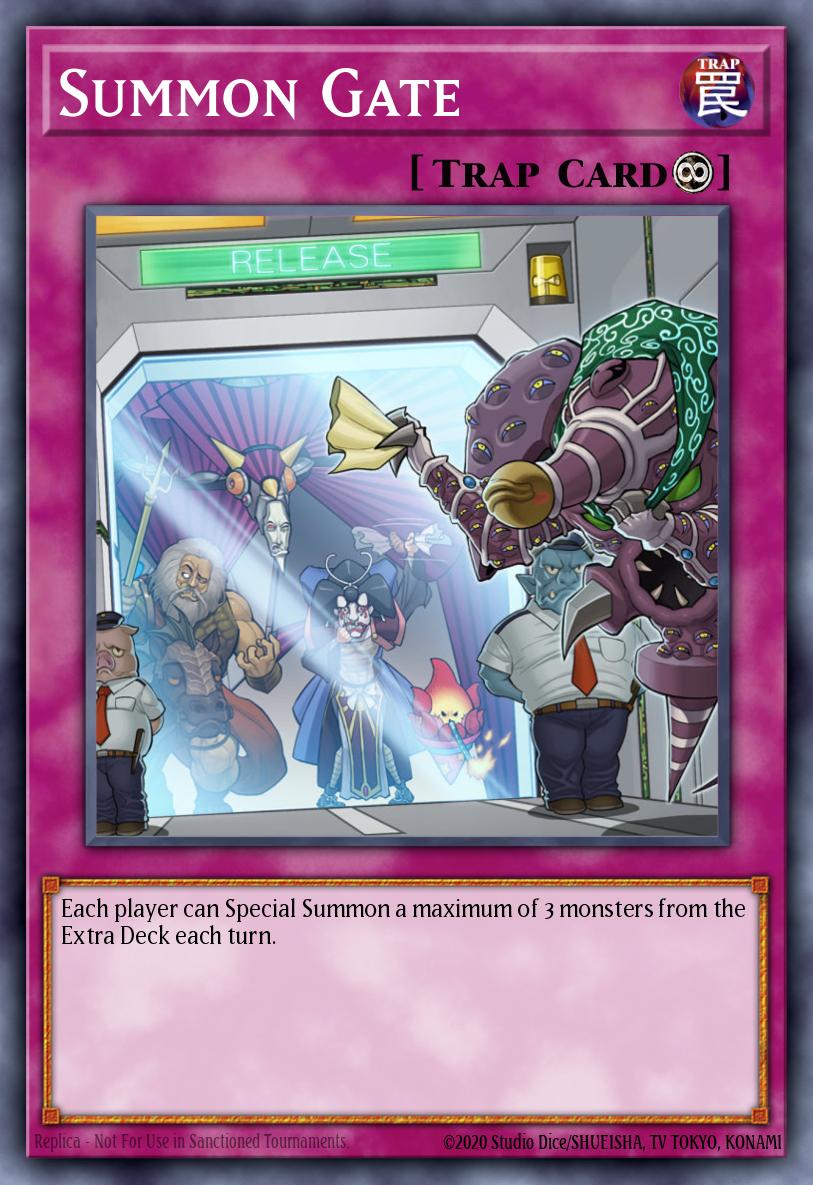
Each player can Special Summon a maximum of 3 monsters from the Extra Deck each turn.
Summon Gate — Power Evaluation
Final Score: 55 ± 8 · Confidence: Medium
- Intrinsic: 58 · Deck: 53 · Meta: provisional
- Primary role: Floodgate/Control · Secondary: Utility
Why it scores here
Summon Gate reliably converts one set Trap slot into a symmetric cap of 3 Extra Deck Special Summons per player per turn, which is a real floodgate against Extra Deck-dependent boards. Its score comes from that restriction and its cheap single-copy cost, not from any card advantage or board-building, since no combo evidence exists to show it building anything. The 181-of-181 deck inclusion across 30 archetypes confirms the card is practical and accessible; it is not treated as proof of power (guardrail 3). The restriction also binds the controller's own Extra Deck plays, so it carries a self-locking modifier.
Axis scores
| Axis | Score | Evidence |
|---|---|---|
| Accessibility | 55 | Runs as a main-deck card in all 181 sampled decks at 1.14 copies average, with no searcher or combo route in the evidence, so access is observed through generic draw and set-ahead play (observed). |
| Combo & Conversion | 15 | No combos_evidence rows exist (total_combos 0), and the text only restricts summons and builds no board, so conversion is near zero (inferred). |
| Resource Economy | 10 | The text gives no card advantage, draw, or recursion, so the card is an even-to-negative resource exchange at best (verified from text). |
| Effect & Interaction | 65 | The text restricts every player's Extra Deck Special Summons to 3 per turn, a hard limit that is hard to play around for Extra Deck-reliant boards, though it can be removed from the field (verified from text, inferred strength). |
| Material Utility | 5 | A Trap card cannot be used as material, so this axis is near zero by definition (verified from card type). |
| Resilience & Flexibility | 50 | As a face-up Continuous Trap it lasts multiple turns but is exposed to backrow removal, and it has no redundancy within the card itself (inferred). |
| Deck-Building Efficiency | 70 | Runs as a single copy in most decks with no garnet, lock, or brick restriction, so the slot cost is low (observed from copies_per_deck distribution, 162 of 181 decks at 1 copy). |
Calculation
Weight profile: Floodgate/Control primary; no secondary blend applied (secondary role is Utility, a minor descriptor only). Intrinsic ≈ 58, Deck ≈ 53, Meta = provisional. Modifiers: Self-locking restriction (-3). Final formula: 0.40*Intrinsic + 0.60*Deck
Strengths
- Hard, symmetric cap on Extra Deck Special Summons that affects Extra Deck-dependent boards
- Single-copy, low-cost slot with no garnet or lock requirements
- Broad deck fit: observed in 181 of 181 sampled decks across 30 archetypes
Weaknesses
- Restricts only Extra Deck Special Summons, so Main Deck summons are unaffected
- Symmetric effect that also limits the controller's own Extra Deck plays
- No combo, search, or resource contribution; its value depends on the opponent's deck
- Vulnerable to backrow removal while face-up
Counters / choke points
- Backrow removal or destruction of the face-up Continuous Trap (inferred)
- Decks that rely mainly on Main Deck summons and card effects rather than the Extra Deck are largely unaffected by the cap (inferred from the card text)
Best use
Floodgate against Extra Deck-reliant opponents, run as a one-copy backrow restriction. Decks: Branded, Relinquished, Predaplant, Phantom Beast (Chimera). Suggested copies: 1.
Evidence & gaps
- Verified: Card text: each player may Special Summon max 3 monsters from the Extra Deck per turn; Card type: Continuous Trap, so it cannot be used as material; 181 sampled decks run it in the Main Deck, 91.7% of them in gameplay type 7
- Observed: Average 1.14 copies per deck; 162 of 181 decks run one copy; Inclusion across 30 distinct archetypes, led by Branded at 17.7%; Top partner co-occurrence led by Ash Blossom & Joyous Spring at 90.6%
- Inferred: Restriction is most impactful against Extra Deck-reliant boards; Backrow removal is the main way the continuous effect is shut off; Self-restriction is a real cost for the controller
- Data gaps: no combos supplied: combo conversion is text-only inference no guides supplied no banlist token: assumed 3 copies (unlimited) no usage statistics (StatisticsCard): archetype inclusion inferred from deck sample only no recorded duel data showing how often opponents' Extra Deck plays are actually restricted